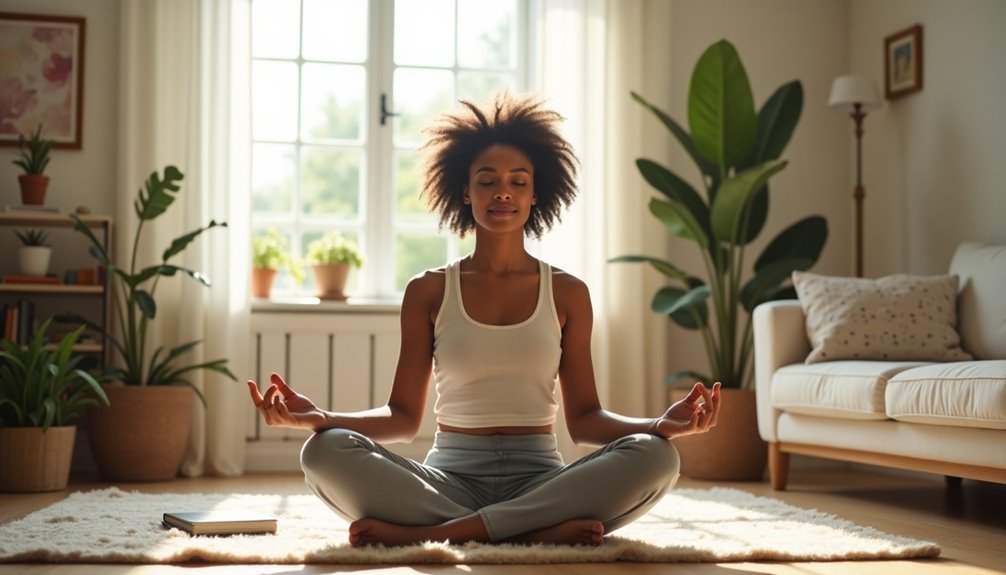

Ever feel like you’re hurtling through life on autopilot? Here’s a thought: what if you could steer each moment with intention?
You’ve heard the buzz about mindfulness, but let’s cut through the fluff. Imagine savoring your sandwich like it’s a five-star meal or walking as if each step’s a dance move. It’s not just Zen talk—it’s about crafting a day that feels less like a to-do list and more like a choose-your-own-adventure.
Welcome to intentional living, friend.
Listen to what this article is about:
Key Takeaways
- Intentional living involves making conscious choices aligned with values and aspirations.
- Mindfulness in daily life, such as mindful eating and walking meditation, can cultivate a sense of presence and reduce stress.
- Active listening is crucial for enhancing communication and fostering genuine connections with others.
- Practicing gratitude and self-reflection through activities like gratitude journaling can enhance daily experiences and interactions.
Understanding Intentional Living
Intentional living is a lifestyle that requires you to be conscious of your daily choices, ensuring that your actions align with your values and aspirations.
You know, waking up each day not just because your alarm clock screams at you, but because your soul does. It’s about making conscious choices that stomp on the status quo because, let’s be honest, who hasn’t dreamt of being a bit of a rebel with a cause?
You’re not just picking out what socks to wear; you’re selecting the threads that represent your life purpose, right down to the last polka dot. It’s about sipping that artisanal coffee and pondering whether it fuels your aspirations or just your caffeine addiction.
And as you navigate through the treacherous sea of life’s options, remember: every choice is a building block in the quirky little LEGO set that’s your existence.
So, embrace that slightly sardonic smile as you realize that yes, even choosing to binge-watch that new series can be a testament to your personal manifesto—if it’s the one that ignites joy and maybe, just maybe, a dash of inspiration.
Welcome to the tribe of the intentional. Welcome home.
Cultivating Mindful Eating
Your journey towards intentional living isn’t just about the grand gestures; it’s in the way you eat your meals, turning mindful eating into a cornerstone of your daily practice. Let’s face it, you’ve probably inhaled a sandwich while distracted by the latest cat meme without even tasting it. But here’s a novel idea: conscious chewing. That’s right, actually experiencing the texture and taste of your food rather than treating your digestive tract like a garbage disposal.
And while you’re at it, why not try savoring flavors? You know, that thing where you pay attention to the seasoning rather than shoveling it in like you’re stocking up for hibernation. It’s about quality, not quantity. Taste your food as if you’re a judge on some pretentious cooking show, minus the dramatic eye rolls and withering critiques.
By eating mindfully, you create a sense of community with your fellow slow-food enthusiasts. It’s a shared rebellion against the cult of speed-eating. So, slow down, chew thoughtfully, and join the ranks of those who know that a meal is more than just fuel – it’s a ritual to relish, bite by bite.
Welcome to the table of intentional living.
Embracing Walking Meditation
So, you’ve mastered the art of shoveling food into your mouth with a hint of Zen, but what about those other monotonous moments—like walking?
It’s high time you turn your daily trudge into a parade of presence with walking meditation.
Let’s march straight into how mindful steps can stop you from sleepwalking through life and the nifty techniques to keep your wandering mind from, well, wandering.
Mindful Steps Benefits
Embracing walking meditation can markedly enhance your focus and reduce stress as you move through your daily activities. Mindful breathing isn’t just for those serene yogis on your Instagram feed; it’s for you, too, as you dodge sidewalk puddles and navigate the urban jungle. Integrate conscious choices into each stride, and you’ll find the chaos of your commute transforms into a symphony of self-awareness.
| Step | Benefit | Witty Remark |
|---|---|---|
| 1 | Sharpens Focus | Like a laser beam in a cat video. |
| 2 | Eases Anxiety | More calming than a bubble wrap pop. |
| 3 | Enhances Awareness | You’re practically Sherlock now. |
| 4 | Boosts Mood | Who needs a happy hour now? |
Ah, the art of walking without walking into a lamppost – it’s a skill, and you’re mastering it, one mindful step at a time.
Walking Meditation Techniques
Through the lens of mindful living, you’ll discover that walking meditation isn’t just about the steps you take, but also about the way you engage with the world around you. It’s the art of sauntering through life with sensory awareness, where every breath could be a plot twist, and pace variation is your personal dance move in the flash mob of existence.
Embrace the quirks of walking meditation:
- Sensory awareness:
- Feel the conspiracy of gravity beneath your feet.
- Hear the whispers of the wind, spilling secrets meant just for you.
- Pace variation:
- Slow down like you’ve got all the time in the world.
- Speed up as if you’re late to your own surprise party.
Practicing Active Listening
You’ll often find that practicing active listening significantly enhances your interactions with others, grounding you in the present moment. It’s not just about letting the sound waves bounce off your eardrums while you plan your grocery list. Nope, it’s about focused attention and conversation mindfulness, which is a fancy way of saying, ‘Actually listen, buddy.’
Think of yourself as a conversational ninja, agile and fully present, dodging distractions and mind-numbing boredom with the grace of a gazelle. You’re not just waiting for your turn to speak; you’re absorbing every word, every pause, every inflection like a sponge at a water party. It’s more than the polite nodding and the occasional ‘uh-huh.’ It’s understanding that every ‘How’s your day?’ could be the prelude to a symphony or the same old pop song.
Active listening is the secret handshake of the socially adept, the glue of genuine connection. When you master it, you’ll find yourself part of a tribe that values real talk over small talk. So tune in, drop out the noise, and maybe, just maybe, you’ll transform a mere chat into an epic tale of human connection.
Incorporating Gratitude Routines
How can you weave gratitude into your daily life as seamlessly as you’ve adopted active listening, enhancing your experiences and interactions even further? For starters, you’re not just mindlessly saying ‘thanks’ to your barista; you’re recognizing the art in your latte foam. Welcome to the world of gratitude journaling and appreciation sharing, where every little ‘thank you’ is an ode to the universe for not tripping you on the sidewalk today.
Gratitude journaling isn’t just another chore:
- It’s your chance to play favorite with your day’s moments, scribbling about the good before the bad can even get its shoes on.
- Think of it as your daily gossip session with positivity, spilling all the good tea.
Appreciation sharing, on the other hand, isn’t about throwing compliments around like confetti—although, why not?
- It’s about:
- Creating a secret club of kindness, where the password is always a sincere gesture.
- Finding a way to say ‘You matter’ without sounding like you’re reading from a self-help book.
Prioritizing Self-Care
You’ve turned self-neglect into a competitive sport, but guess what? It’s time to hang up your sneakers.
Embrace the self-care essentials, ritualize your daily reboot, and practice setting boundaries like it’s your new religion – your sanity will thank you.
Self-Care Essentials
Self-care strategies are integral to intentional living, allowing you to replenish your energy and maintain focus on your mindfulness journey. Oh, you think you’ve got it all sorted with that cucumber water and occasional yoga class? Think again. Prioritizing self-care isn’t just about feeling good; it’s about survival in this caffeine-fueled, notification-blasted world.
- Stress management:
- Learn to say ‘no’ without explaining yourself.
- Meditate, or just sit quietly pretending to meditate while you actually plan your lunch.
- Sleep hygiene:
- Banish screens from the bedroom. Yes, that includes your beloved phone.
- Create a sleep schedule, because nothing says ‘I’m an adult’ like a bedtime.
Daily Rituals Impact
Building on your self-care toolkit, incorporating daily rituals into your routine can significantly enhance your mindfulness practice and amplify the benefits of intentional living.
Let’s face it, your morning routines currently consist of hitting snooze four times and scrolling through a sea of notifications before the coffee even hits. Here’s a wild thought: swap out the screen-time for some serene time. Yes, that means actually enjoying your coffee rather than wearing it as a caffeine-infused perfume.
Come evening, engage in some reflection that doesn’t involve a mirror. It’s about pondering your day’s triumphs and, let’s be honest, those face-palm moments. It’s self-care with a side of reality check – because who doesn’t need a reminder that they’re not, in fact, a robot?
Setting Boundaries Practice
In the midst of your bustling life, setting boundaries is crucial for ensuring that self-care isn’t relegated to the bottom of your to-do list. Let’s face it, your calendar often looks like it’s in a committed relationship with chaos, doesn’t it? But here’s the thing:
Boundary clarity:
- Just say no to that extra project your colleague ‘thoughtfully’ pitched your way at 4:59 PM.
- Protect your zen like it’s the last slice of pizza at a party.
Respectful assertiveness:
- Speak up when your in-laws ‘casually’ invite themselves over for the third weekend in a row.
- Guard your me-time as fiercely as a cat defending its favorite sunspot.
Enhancing Present-Moment Awareness
Cultivating present-moment awareness can significantly elevate your daily experiences by anchoring you in the here and now. Picture this: you’re practicing focused breathing, conscious relaxation, and suddenly, it’s as if life’s volume knob has turned down just enough for you to hear yourself think. Let’s face it, your mind often runs wild like a reality TV show that’s had one too many seasons. But here you are, tuning into the simplicity of your own breath—and who knew air could be so interesting?
Now, don’t go expecting a standing ovation from your inner critic for this newfound mindfulness. That guy’s tougher to please than a cat with a PhD in philosophy. But here’s the scoop: as you embrace the present, you’ll start to feel like you belong to a secret club. The kind where members know the secret handshake of inner peace, exchanging knowing nods while the rest of the world hustles by, oblivious.
Frequently Asked Questions
How Does Intentional Living Through Mindfulness Compare With Traditional Time Management Techniques in Terms of Productivity and Stress Reduction?
You’re juggling tasks like a circus act, but mindfulness isn’t your typical time-blocking gig. It laughs in the face of multitasking, boosts productivity, and slashes stress while screaming, “Join the zen squad!”
Can Intentional Living Through Mindfulness Have Any Long-Term Effects on One’s Physical Health, Such as Blood Pressure or Immune Function?
You’re onto something: mindfulness can boost your immune system and keep that blood pressure in check. Mix in mindfulness nutrition and better sleep quality, and you’re practically invincible. Welcome to the healthy insiders’ club.
Are There Specific Cultural or Spiritual Backgrounds That Particularly Align With or Contradict the Principles of Intentional Living Through Mindfulness?
You’ll find cultural adaptation often embraces mindfulness, while spiritual skepticism might give you the side-eye. Don’t let it ruffle your zen; belonging within, not in the raised brows of naysayers.
How Can Parents Integrate the Principles of Intentional Living and Mindfulness Into Their Children’s Daily Routines and Education?
Like a modern-day Mary Poppins, you’ll sprinkle mindful play into their schedule, fostering emotional literacy before they’ve even packed their school bag. It’s not just supercalifragilistic, it’s an intentional life lesson in disguise.
In What Ways Might Intentional Living Through Mindfulness Impact Interpersonal Relationships and Conflict Resolution?
You’ll find your squabbles simmering down when you mix in a dash of emotional awareness. Mindfulness sharpens compassionate communication, turning potential brawls into bonding moments. Welcome to the chill zone of conflict resolution.
Conclusion
So, you’ve dabbled in a bit of intentional living—chewed thoughtfully, strolled meditatively, listened like you mean it, and showered yourself with gratitude and self-care. But has it morphed your daily grind into a whimsical dance with the present? Perhaps not entirely.
Yet, imagine a day sprinkled with such mindful moments. Wouldn’t life taste just a bit sweeter? Go on, embrace the charm of now with a wink and a nod—your future self might just thank you for the giggle.